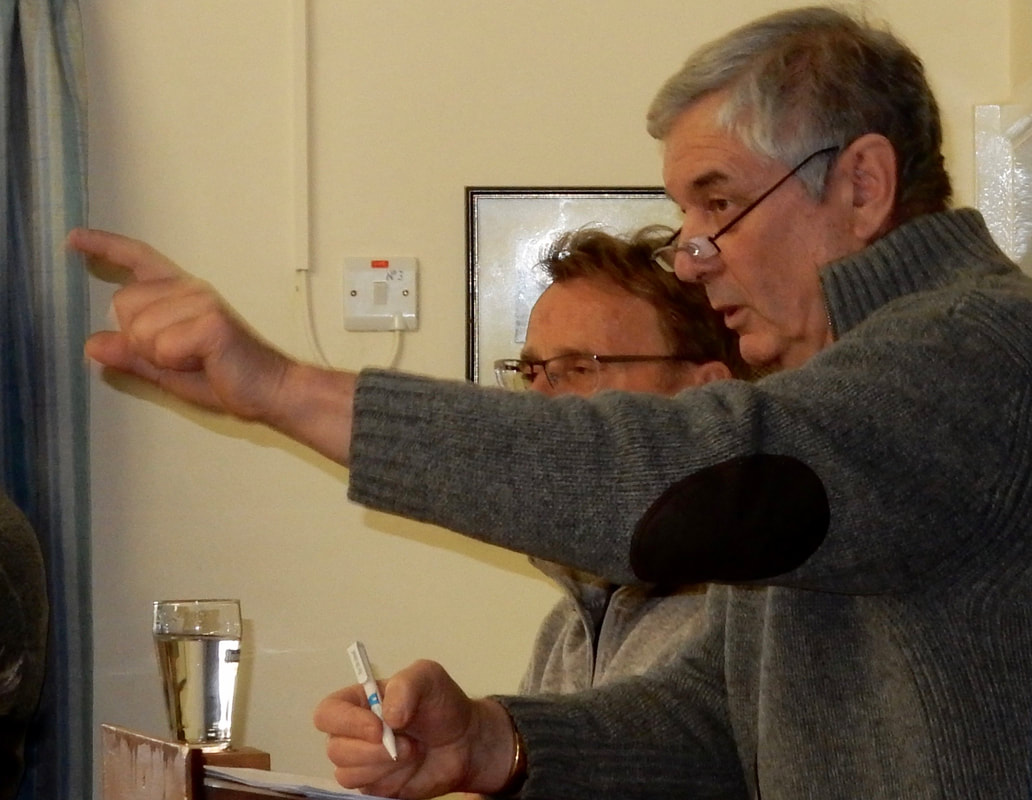
Taunton's popular spring equipment auction is back after a two year absence! It takes place on Sunday, 3 April, 2022 at Ruishton Village Hall, Taunton, Somerset TA3 5JD.
There's sure to be a miscellany of second hand hives, smokers and honey extraction equipment. Auctioneer Chris Harries will be wielding the gavel for the 36th time and urged beekeepers to make sure they were well prepared for the coming season. “Bees don’t wait for anybody!” said Chris. “This is a great opportunity to get ahead of the bees. Beekeepers need to have their equipment ready to go if they’re going to be able to cope once the bees ‘wake up’.” Beekeeping involves a considerable amount of equipment, protective clothing, hive tools, a smoker, a feeder to provide bees with sugar syrup if needed in the winter, a good reference book, honey extraction equipment and among many other items of paraphernalia. Chris, who runs Sedgemoor Honey, added: “We always get a good selection of equipment and someone just taking up the craft could quite easily get started and save money. But buyers need to remember to thoroughly clean any equipment to prevent the spread of diseases.” Items received from 10:00am Auction starts at 2:00pm Refreshments Raffle Free car parking  A petition instigated by Somerset beekeepers and calling on government to do more to clear the supermarket shelves of adulterated honey is live.
https://petition.parliament.uk/petitions/607735 Honey selling for as little as 69p a pot has been spotted in Somerset shops. Large quantities of imported honey – mainly from China – are believed to be cut with cheap fillers. Consumers are not given the information on the labels to make an informed choice. Somerset BKA seconded Devon BKA’s propositions at the BBKA’s Annual Delegates Meeting last month calling on the BBKA to join efforts to stamp out adulterated honey. They were passed by an overwhelming majority. A petition created by some of the people behind the propositions – from Somerset and Devon – is calling for government to do more. There’s been a long standing, but light hearted, rivalry between Devon and Somerset. Let’s carry on that tradition and see if we can get more signatures than Devon! The petition calls for a full review of the honey market and Honey Regulations, to review evidence of honey fraud within the honey market, and reform regulations and arrangements for enforcement, to prevent future fraud. Honey is adulterated, purely for profit, on an industrial scale across the globe. We believe current measures to ensure authenticity of honey are woeful. Public health, the free market, livelihoods, food security, consumer confidence and bee health issues are all at risk. Current regulations, testing and enforcement are inadequate to protect and inform consumers, and there is a need for an urgent comprehensive review in order to detect honey fraud. Please sign this petition and share it with everyone you know! https://petition.parliament.uk/petitions/607735 [When you sign, you'll receive an automatic email asking you to confirm your signature]. Visit https://www.facebook.com/groups/588674292271458 to find out more about honey adulteration.
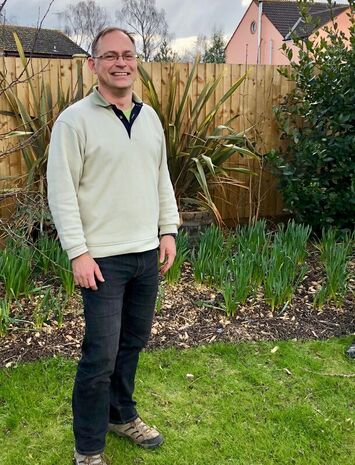
Dr Pete Kennedy (pictured), a Research Fellow at The University of Exeter's Environment and Sustainability Institute, will give us an update on current Asian hornet research and spread in Europe at our AGM on Saturday, 12 March, 2022.
The AGM will be hosted by Burnham division at Burnham and Berrow Golf Club, St. Christopher's Way, Burnham-on-Sea TA8 2PE. Members are very welcome to attend for both the lunch and the lecture which precede the AGM; there will obviously be no charge for lunch if you choose to attend just the lecture and AGM. A two course carvery costs £19 and numbers are required by Friday 4 March 2022. Tea and coffee will be available at extra charge. Please pay by bank transfer to: The Burnham and District Beekeepers Sort code 30-91-20 Account 00881608 If you have any further queries please contact Richard Tiley from Burnham Division at r.tiley@sky.com Dr Kennedy's talk examines the Asian hornet Vespa velutina, an invasive alien species, that is rapidly spreading through parts of Europe. Living in large nests of 5,000 to 20,000 individuals, Asian hornets are voracious predators of insects – including honey bees, wild bees and wasps. They are having a significant impact on the viability of beekeeping and honey production in mainland Europe, and they have been poised to spread into the UK over the last five years, where they could pose a significant threat to both wild and managed pollinators. This could jeopardise the essential pollination service these species provide to crops and wild flowers. "Efforts to halt or limit the spread of the Asian hornet in the UK are reliant upon finding and destroying nests as soon as possible. In 2017, in response to a request by Defra, we developed a new method for finding Asian hornet nests, by radio-tracking individual hornets as they flew back to their nests (Kennedy et al 2018). We now have two research projects, collaborating with our European partners (funded by BBSRC and funded by EU Interreg Atlantic Area) to further develop this technique and find new ways of managing the spread of the Asian Hornet. At the same time, we are actively measuring and modelling the potential impact of this invasive species on wild and managed pollinators to understand the level of threat posed by this invasive species." Timetable: 1200hrs - Arrive 12.30hrs - Two course carvery lunch 1400hrs - Welcome 14.05hrs - Lecture: "Asian hornets: An update on current research and spread in Europe" with Dr Pete Kennedy from Exeter University. 15.5hrs - Afternoon tea 15.30hrs - AGM  Well! It’s the end of another year and, as always, somebody will chime up with ‘and it’s been a strange one’. It now seems that every year defies what we would like to consider as the norm. It was, for most, a poor year for honey harvests with my own crop down by two thirds, but reading an article recently, I realised that honey harvests have been declining for many years, and you don’t have to look far to see why. Ten years ago, the field opposite was alive with dandelions in the springtime, and the adjacent orchard, which also hosted dandelions, was awash with apple blossom in late April. No more. All fields in the vicinity have been sprayed with weedkiller and daren’t produce a single dandelion, and the trees in the orchard have been left to their own devices for so long, that most have fallen over. The sheep take care of the dandelions there, and it is soon to become the site of eight up-market houses.
What good news then? There seems to be an upsurge in beekeeping interest. At the beginning of the year, because of COVID restrictions, I hosted a Zoom course which attracted 100 ‘would be’ beekeepers from far and wide, although originally intended for Somerset residents only. They came from Cornwall, South Wales and even Whitley Bay: not to mention Channel 4 property guru Sarah Beeny. To put the tin lid firmly on that one, during October, I was sitting in a car park in Cape Cornwall, near Land’s End, and I rolled down my car window to ask a passing birdwatcher if he had seen anything interesting. He pointed at me accusingly and said ‘I know you!’ For a moment I was worried. Still pointing, he said ‘You’re the bee man!’. It seems he had been on the course, and although I couldn’t see him, he had been looking at my mug and listening to my voice for six weeks during the previous winter. Most divisions of Somerset BKA will be holding courses again this winter, but thanks to the Omicron variant, only time and the wisdom of our illustrious leader will decide if these can be held in person, or will be broadcast from ‘lofty garrets’ all over the county. Either way, there is one element of good news. Becky Wright, who is a motivational speaker, specialising in workplace wellbeing, has donated a significant sum of money to Somerset Beekeepers Association to enable someone, or a group, who would otherwise find it financially difficult to take up beekeeping, to be able to do so with a hefty financial subsidy. Nominations (with as much background as possible) should be sent to Maggie Norris – secretary of Somerset Beekeepers Association, as soon as possible. You can nominate yourself, another person or a project, but give as much information as you can. Maggie will give you all the details and conditions of the New Leaf Award. It only remains for me to wish you all a successful beekeeping new year, and I hope that all other aspects of your lives will bring what you wish for. In the immortal words of most beekeepers ‘It’s got to be better than last year’. Stewart Gould Chair of Somerset BKA 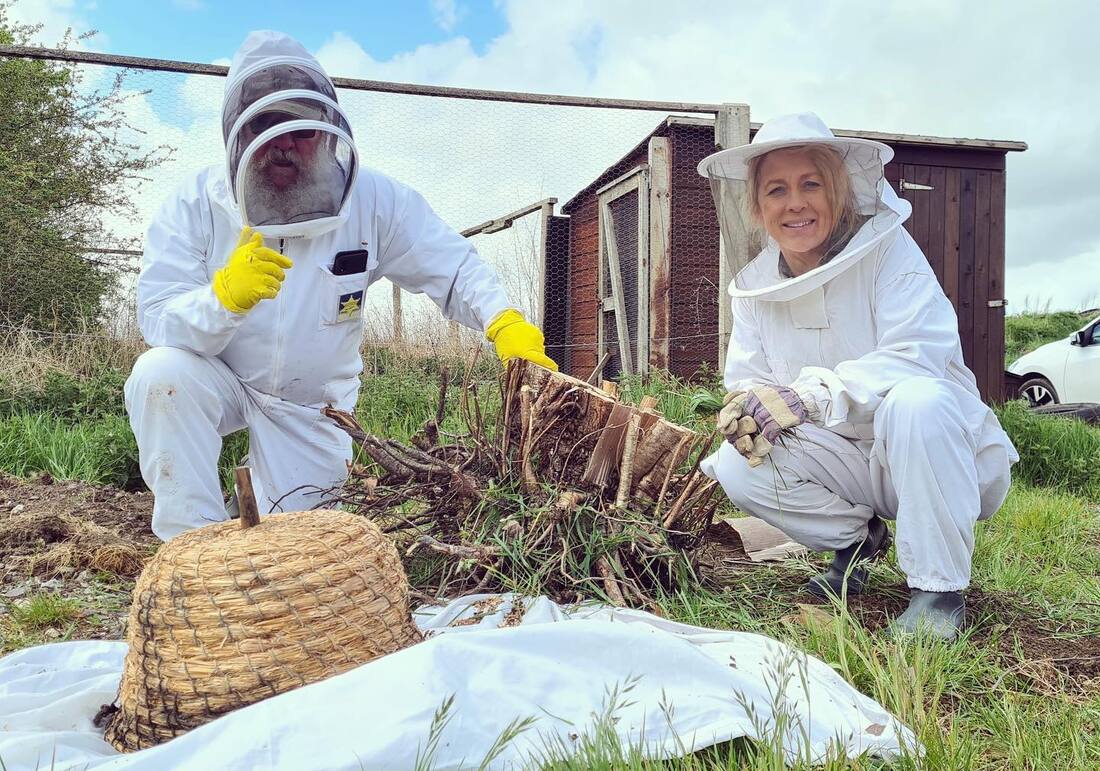 In Sarah Beeny’s latest Channel 4 series – New Life in the Country - she continues her beekeeping story after attending an online beginners’ course run by Somerton Division.
In the first episode of the new series Sarah catches a swarm with her beekeeper mentor Lionel Horler. She shares the experience on her Facebook page saying: “I’ve learnt so much over the past year from the amazing Somerset Beekeeping [sic] Association - thank you Lionel for showing me such a magical moment.”  A new pressure group made up of UK beekeepers - Honey Authenticity Network UK (HAN UK) - is calling for better information for shoppers starting with stricter labelling for honey blends.
Two members of Somerset BKA are members of HAN UK – Lynne Ingram is Chair and Anne Pike is a committee member. The group’s first outing in the media was in the Observer on Sunday, November 29, ’21. ”British beekeepers are calling for a requirement on supermarkets and other retailers to label cheap honey imports from China and other nations with the country of origin after claims that part of the global supply is bulked out with sugar syrup. The UK is the world’s biggest importer of Chinese honey, which can be one sixth of the price of the honey produced by bees in Britain. Supermarket own-label honey from China can be bought for as little as 69p a jar. Supermarkets say every jar of honey is “100% pure” and can be traced back to the beekeeper, but there is no requirement to identify the countries of origin of honey blended from more than one country. The European Union is now considering new rules to improve consumer information for honey and ensure the country of origin is clearly identified on the jar.” To read the article in full, click here. Meanwhile, the group has set up a Facebook group to raise awareness of honey adulteration. Anyone interested in the subject is warmly invited to join. 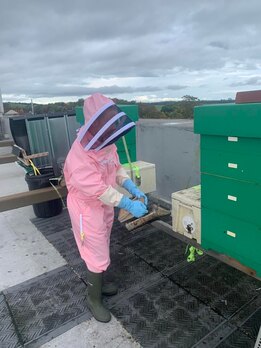 Somerset BKA and Bee Diseases Insurance Ltd (BDI) are jointly funding PhD student Hollie Pufal at Newcastle University.
Hollie is exploring the virulent ST2 strain of EFB which is uniquely associated with Somerset and north Dorset. Hollie and her supervisor Prof Giles Budge will be involved in our Lecture Day on 12 February, 2022. After completing her first year, she has provided a brief report on her work to date: "Thank you for your generous funding that has allowed me to pursue research in this exciting area. Over the past 6 months I have been establishing methods to develop a molecular workflow that could be used to generate whole genome sequencing data from infected larvae at outbreak sites, I also tested supers from infected apiaries for the presence of EFB. I tested 4 locations on each frame for the presence of EFB, as well as capped honey and pollen, using DNA extractions and Realtime PCR. The results showed only a small trace of EFB in a couple of samples both from the frame, pollen and honey. I plan to sequence using handheld sequencing technology, which is a cheaper and more efficient sequencing platform, so has the potential to be used more readily in the future for assessing EFB outbreaks. The issue with sequencing infected larvae material is that most of the sequence generated will be honeybee DNA, so I originally tested various methods that deplete the bee DNA and enrich the bacterial DNA. Initially I used homogenised larvae mixed with M.plutonius culture and then I moved on to infected larvae from the field. I used qPCR assays to detect both EFB and insect DNA to assess the efficiency of the depletion methods, and I now have a selection of promising methods that I will take forward to sequencing and assess the quality." 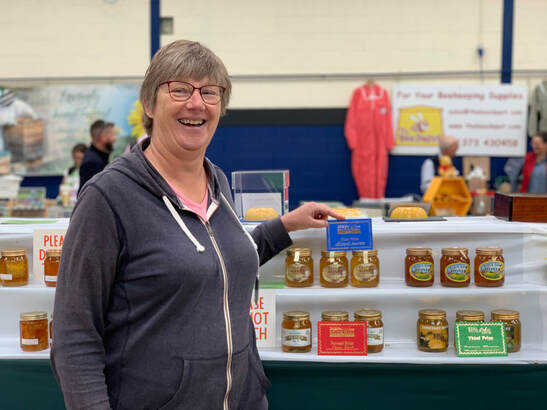 Thousands of visitors poured into the bees & honey feature at the Bath & West at the end of August.
Their first stop was Somerset’s Asian hornet action team’s stand which had lots to attract attention including pinned specimens, a nest, information to give away and colouring in sheets for children. Further round the building they had the chance to watch live bees in an observation hive and, on the Somerset stand, see some of the fruits and vegetables pollinated by insects and talk to beekeepers about this fascinating craft. Winner of the Blue Ribbon for the best exhibit in the honey show was Somerset member Bridget Knutson from Cheddar with three jars of this season’s honey; she will take these jars to the National Honey Show in October. Successful showing couple Mark and Christine Gullick from Axbridge will also be exhibiting at the National Honey Show buoyed by some excellent first place cards. Somerset beekeepers ask the public to take part in Asian hornet week – September 6-10, 20215/9/2021
 Somerset beekeepers are calling on the public to protect honey bees and other pollinators during Asian hornet week which runs from September 6-10.
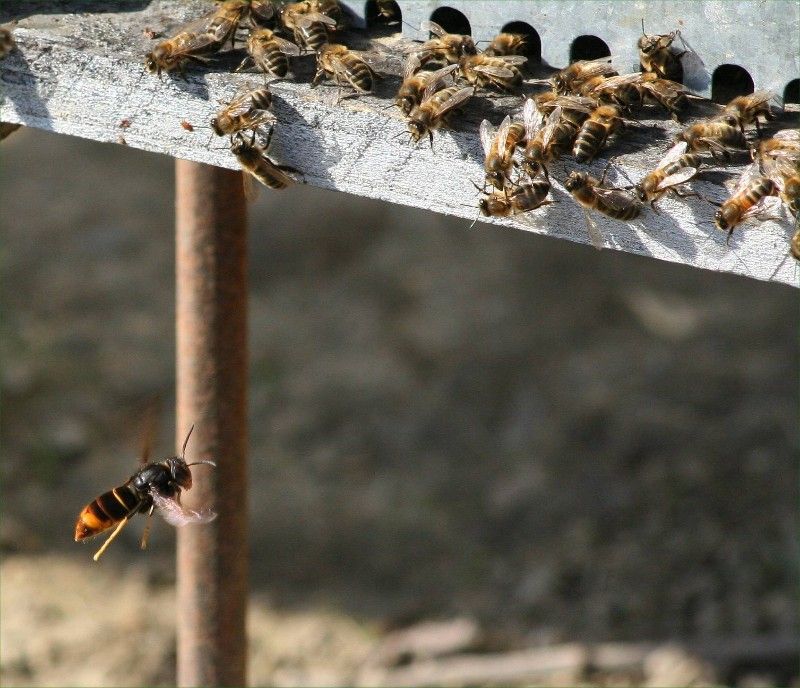
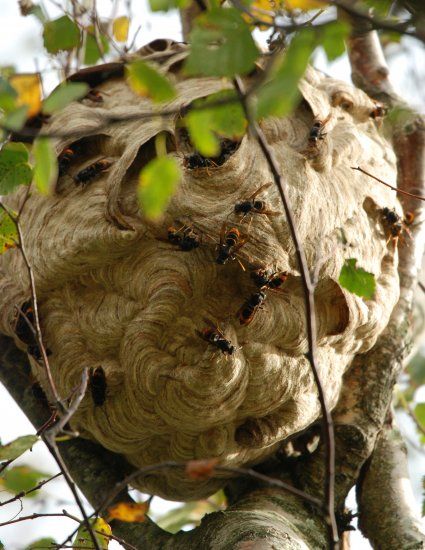
Lynne Ingram, co-ordinator of Somerset’s Asian hornet action teams, said if these Asian yellow-legged Asian hornets get a hold in the county they could decimate native insects. “Research suggests that the South West is an area where Asian hornets are likely to occur,” said Lynne. “Even though there were no sightings here last year, possibly because of lockdown, we still need to be vigilant.” Asian hornets are widespread in France and other European countries and have been accidentally brought into the UK in vehicles. In the coming weeks beekeepers will be checking their apiaries and monitoring traps for Asian hornets. The county’s Asian hornet action teams are standing by to respond to sightings in the first instance and to support the National Bee Unit’s team of inspectors who track down and destroy nests. The awareness week is backed by TV presenter and British Beekeepers Association patron Jimmy Doherty: “Asian hornets really do pose a threat to our native pollinator insects and if you were to come across a nest it could cause you a bit of a danger, too. “This time of year, as the leaves begin to drop, their nests are easier to spot. If you’re unsure what to look for there is an app to download for your smartphone called Asian Hornet Watch. Take a picture of whatever you spot and send it to us via the app.” Asian hornets are about twice the size of a honeybee, have an orange face and a dark abdomen with an orangey- yellow fourth segment. Its thorax is entirely dark brown or black and velvety, and the insect has bright yellow tips to its legs. Take a photo of any sightings and report immediately to altertnonnative@ceh.ac.uk or use the Asian hornet watch app. For advice, help with identifying a hornet or getting a photo, contact asianhornet@somersetbeekeepers.org.uk. Photos, posters and even a colouring sheet to help identify the Asian hornet can be found on the Somerset Beekeepers’ website: https://www.somersetbeekeepers.org.uk/resources.html Ends Photo: Asian hornet hawking a hive. Photo credit: Crown copyright 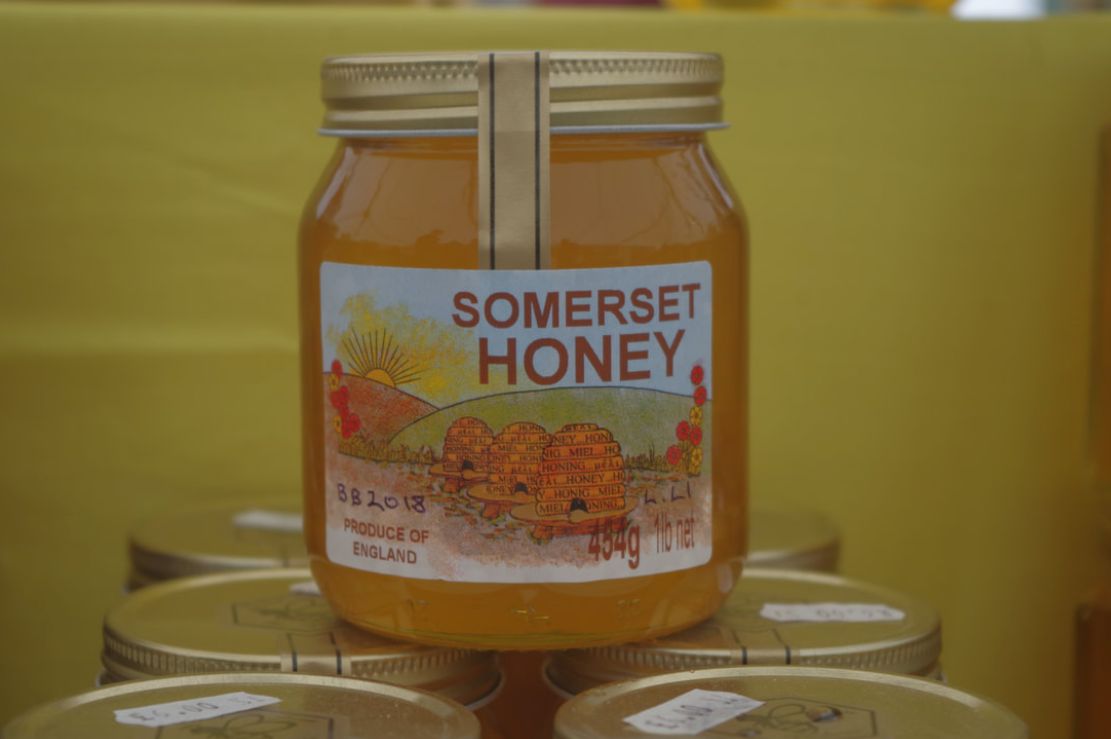 SBKA Chairman Stewart Gould provides a timely update about pre-used honey jars and lids:
As there is much confusion regarding the re-use of honey jars and lids, I contacted the Food Standards Agency for their thinking on the topic. Previously they had told me that jars should not be re-used, but several years later, they seem to have relaxed that view. Please read their response carefully, as it isn't plain sailing. Dear Stewart Thank you for your enquiry, I hope the following proves of assistance to your members. Food Business Operators (FBO) are responsible for ensuring the food they place on the market is safe under retained European Regulation (EC) 178/2002 - Article 14, and thus the duty and onus is on the FBO to ensure that the food they place on the market is fit for human consumption. Decisions on whether to re-use returned jars and how potential risks should be managed is a decision of the business owner. https://www.legislation.gov.uk/eur/2002/178/article/14 Re-using glass containers like jam jars occasionally to supply food does not present a food safety concern. This means it is safe to sell home produced honey in re-used jars at village fetes and other occasional events. The key thing is good hygiene – if the jars are re-used they should be free from chips and cracks, and should be clean and sterilised prior to each use. The regulations on food contact materials apply to businesses and these regulations are unlikely to apply to the use of jars for occasional community and charity food provision. For the lids, it is advisable not to re-use these as they have a gasket within that is designed for single use. In this instance, appropriate lids will therefore need to be procured as films are unlikely to be suitable for honey. It would be the decision of the local enforcement authority as to whether any particular reuse constituted an infringement of the legislation, as they are tasked to examine compliance paperwork for food contact materials and the circumstances of the placing of the packaged food onto the market. The legislation on the safety of the packaging your membership will need to comply with is can be viewed at: https://www.food.gov.uk/.../food-contact-materials... For any food contact material or article placed onto the market in England, the relevant regulations will be the Materials and Articles in Contact with Food (England) Regulations 2012 (as amended*) https://www.legislation.gov.uk/uksi/2012/2619/contents/made *The original Regulations for England have been amended as per the following individual amending Regulations and will also need to be referred to: The Materials and Articles in Contact with Food (Amendment) (EU Exit) Regulations 2019 https://www.legislation.gov.uk/uksi/2019/704/made The Food and Feed Hygiene & Safety (Misc. Amendments etc) (EU Exit) Regulations 2020 https://www.legislation.gov.uk/uksi/2020/1504/contents/made The Food and Feed Hygiene & Safety (Misc. Amendments) (England) Regulations 2020 https://www.legislation.gov.uk/uksi/2020/1410/body/made Unfortunately there isn’t a consolidated version that you can refer to at the moment. I hope this proves of value to you and your membership. Best Regards Vince Mr Vincent Greenwood Policy Advisor I Food Contact Materials Food Standards Agency 6th Floor I Clive House I 70 Petty France ILondon ISW1H 9EX Vincent.greenwood@food.gov.uk |
Archives
December 2023
Categories
All
|
 RSS Feed

Somerset Beekeepers Association Charity © 2021 Registered CIO Charity 1206483
Affiliated to the British Beekeepers Association
Click here to view our Privacy Policy
Affiliated to the British Beekeepers Association
Click here to view our Privacy Policy